
Pocket Doors and Barn Doors: Space Savers Compared
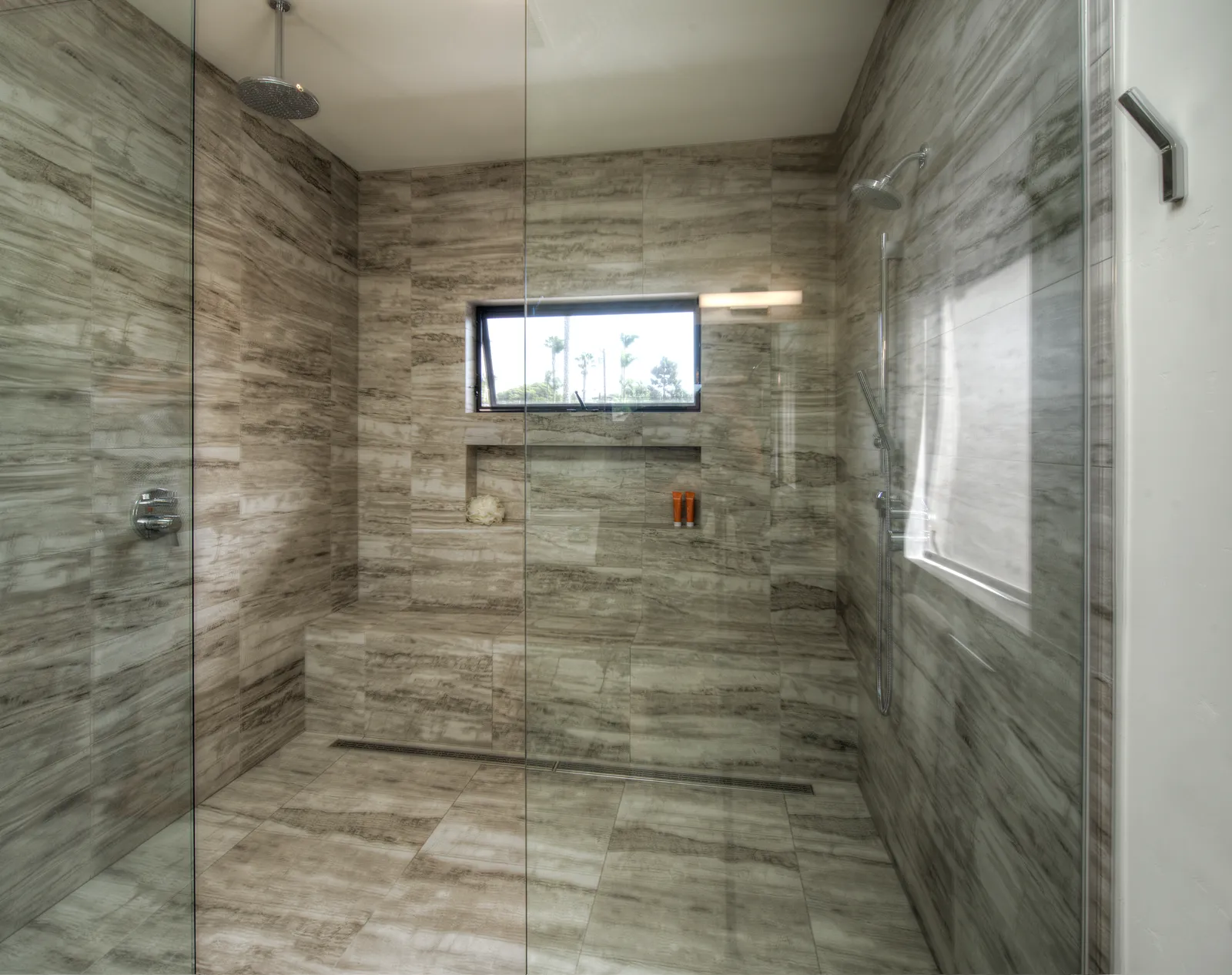
A standard swinging door claims about nine square feet of floor just to operate. In a sprawling house nobody cares. In the compact bathrooms and hallways of San Diego's older housing stock — the midcentury ranches, the beach bungalows — those nine square feet might be the difference between a bathroom that works and one that doesn't.
Enter the two great space savers: the pocket door, which vanishes into the wall, and the barn door, which slides along the outside of it. They solve the same problem in very different ways, and we have a clear opinion about which one belongs where.
Where the pocket door wins
The pocket door is the cleaner solution. Closed, it looks and behaves like a regular door — it seals into a jamb on all four sides, latches properly, and locks. Open, it disappears entirely. For bathrooms, that jamb matters more than people expect: it's what gives you real privacy and keeps shower humidity where the exhaust fan can deal with it. Nearly every tight bathroom remodel we design gets a pocket door somewhere.
The catch is that the pocket lives inside the wall, so that wall can't hold plumbing, switches, or shelving, and installing one in an existing wall means opening it up. That makes pocket doors a remodel decision, not a weekend project — plan them while the framing is already exposed.
Where the barn door wins
The barn door's advantage is that it asks almost nothing of the wall it hangs on. No pocket to frame, no wall cavity to empty — just solid blocking for the track. That makes it the retrofit champion, and the only sliding option when the adjacent wall is full of pipes or ductwork. Done well, with a substantial slab and quality hardware, it can also be a genuine design moment in a hallway or den.
But be honest about what it isn't: sealed. A barn door hovers in front of the opening with gaps on every edge, which means light, sound, and steam all travel freely. As we explained in our post on soundproofing between rooms, the door is usually the acoustic weak point — and a barn door is the weakest version of one. For a pantry, laundry, or office, fine. For the only bathroom near the guest room, think twice.
Either way, buy a real door
Whichever track it rides, the slab itself matters. A hollow-core panel on beautiful hardware still sounds and feels hollow; we made the full case in solid core vs. hollow core. Weight also makes sliding doors glide rather than rattle, especially with soft-close hardware — worth it in both systems.
Our shorthand: pocket doors for privacy, barn doors for personality. If a wall is opening up anyway, the pocket door almost always repays the framing work.
Reworking a floor plan where every square foot counts? Start the conversation or give us a call — we'll find the space your doors have been stealing.
Design · Build · Integration
Let's build something beautiful.
Call (619) 334-3322 or request your free design-build consultation.